
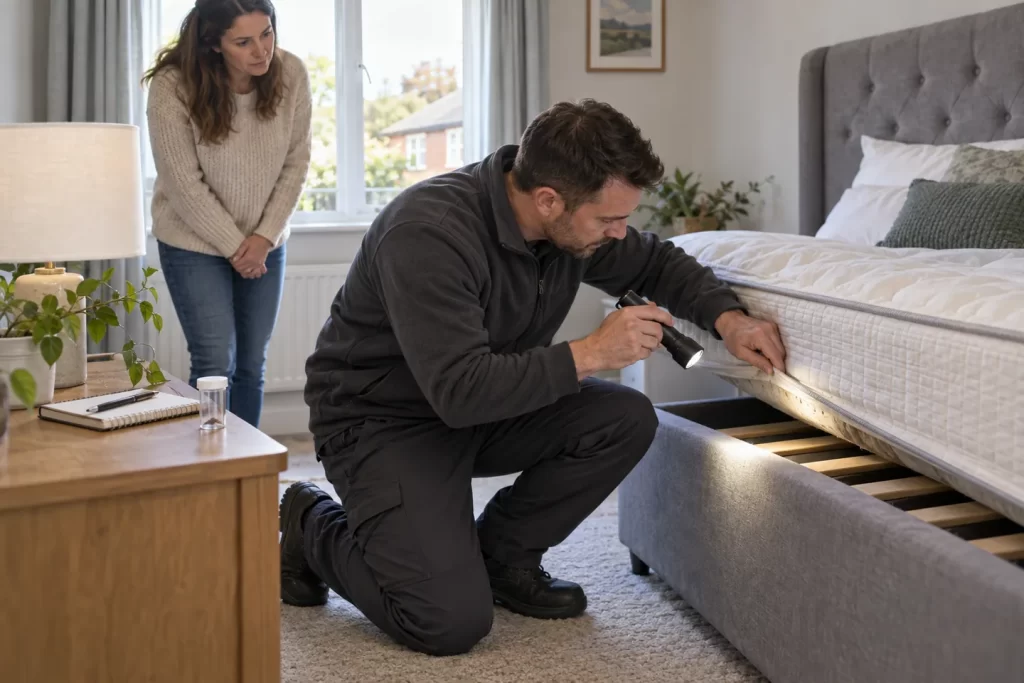
A professional bed bug inspection is an investigation, not a promise that every itchy mark or tiny speck will lead to treatment. The inspector looks for the insects and the physical traces they leave, considers where people sleep or rest, and records what can and cannot be established. That evidence shapes the next decision: whether bed bugs are confirmed, whether more monitoring would help, or whether another explanation needs investigating. Knowing the process beforehand makes the visit more useful and helps you prepare without moving possible evidence around the property.
The British Pest Control Association's bed bug management code calls for a thorough survey before a reliable quotation and says identification matters before pesticide treatment. A good visit therefore begins with questions and an examination rather than an automatic spray. The precise route through your home depends on its layout, the history you provide and any access or safety limits. Ask the provider what their inspection includes when arranging the appointment.
Before the visit: describe what you have actually seen
When booking, explain where and when you noticed the concern. Mention any insect you found, cast skins, pale eggs, dark spotting or recurring activity in a monitor. If you have only skin marks, say so plainly. Bites alone cannot confirm bed bugs; a description of the room and a dated account of events will be more useful than a confident guess about the cause. Tell the provider which rooms are used for sleeping, whether furniture has recently arrived and whether there has been recent travel or a previous treatment.
Keep a safely captured specimen or clear photograph if possible. Put the specimen in a sealed container rather than crushing it on the bedding. Photograph suspected marks in place, with a wider view that shows their location. Write down the date and room. These simple records help an inspector compare a current finding with an earlier observation. They also reduce the temptation to remove bedding, discard furniture or apply an unplanned product before anyone has examined the area.
Tell the inspector about access constraints when you book. A heavy bed against a wall, an occupied room, delicate furniture or a person who cannot easily leave a room may affect what can be checked. Ask whether they need you to make bedside areas accessible, and follow their specific instructions. Do not dismantle electrical fittings or open sealed structural cavities yourself. Professional inspection should work within safe, agreed access.
The opening conversation sets the inspection route
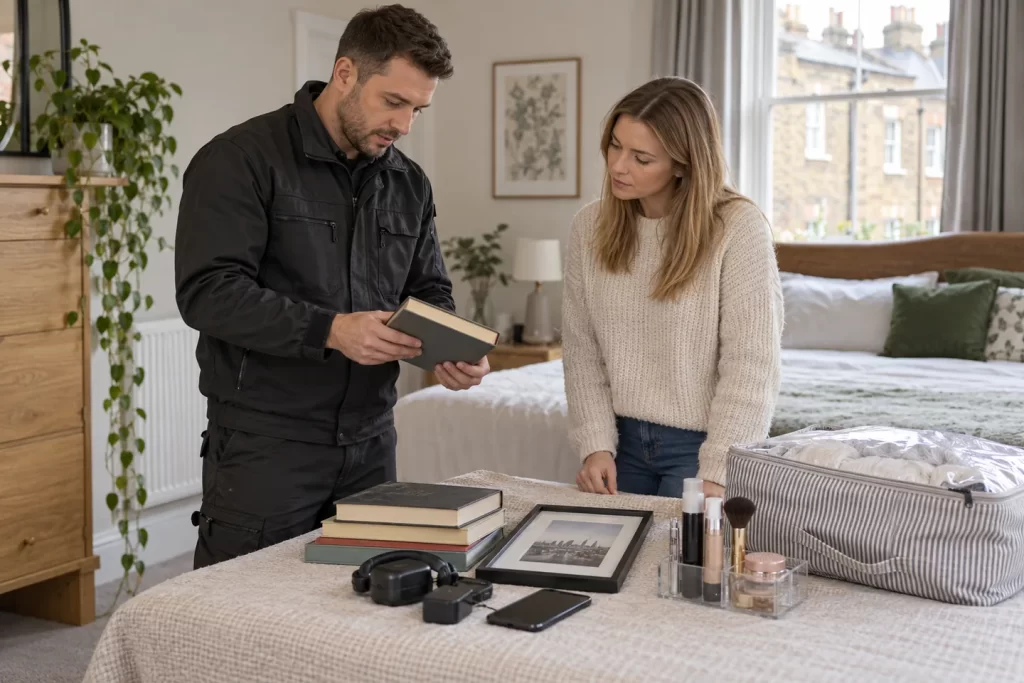
At the property, an inspector will usually review the history rather than assuming that the first reported bedroom is the only relevant place. They may ask where occupants sleep, whether anyone rests regularly on a sofa, when suspected signs first appeared and whether other rooms have shown similar evidence. A clear timeline matters: an insect seen beside a suitcase yesterday and old spotting behind a bed may call for different checks. The inspector should distinguish something personally observed from a report or a photograph.
They may explain what they can reasonably inspect during this visit and what would require extra access or a return visit. If you rent or share the building, explain who can authorise entry to each space. Our guide to bed bugs in a shared house covers why coordinated access and consistent reporting matter. A partial inspection can still be informative, but its limits should appear in the findings.
Beds and resting places receive close attention
Bed bugs tend to hide near places where people remain still, so the inspection commonly starts with sleeping and resting areas. The inspector may look along mattress seams and labels, the bed base and headboard, joints and screw holes, nearby furniture and the junctions around the bed. A torch helps reveal narrow crevices; a close look may be needed to tell an insect from lint or other debris. The scope depends on the furniture and how safely it can be moved or opened.
The inspector is looking for more than a live adult. Eggs, shed skins and characteristic faecal marks may support a finding when correctly identified in context. An isolated dark dot or a mark on skin is not enough by itself. A qualified professional should explain how a finding was identified, and where uncertainty remains. If you want to understand one common trace before the visit, see our guide to bed bug droppings. Avoid cleaning a suspected cluster of marks immediately before the appointment if the provider has asked to see it.
Other likely resting places may be included if the history points there: a sofa used for evening naps, a guest bed or a chair in an adjacent room. This does not mean every possession in the building must be emptied on the first visit. The inspection should follow the evidence and the agreed scope. Opening every cupboard without a reason can scatter belongings and make the original pattern harder to interpret.
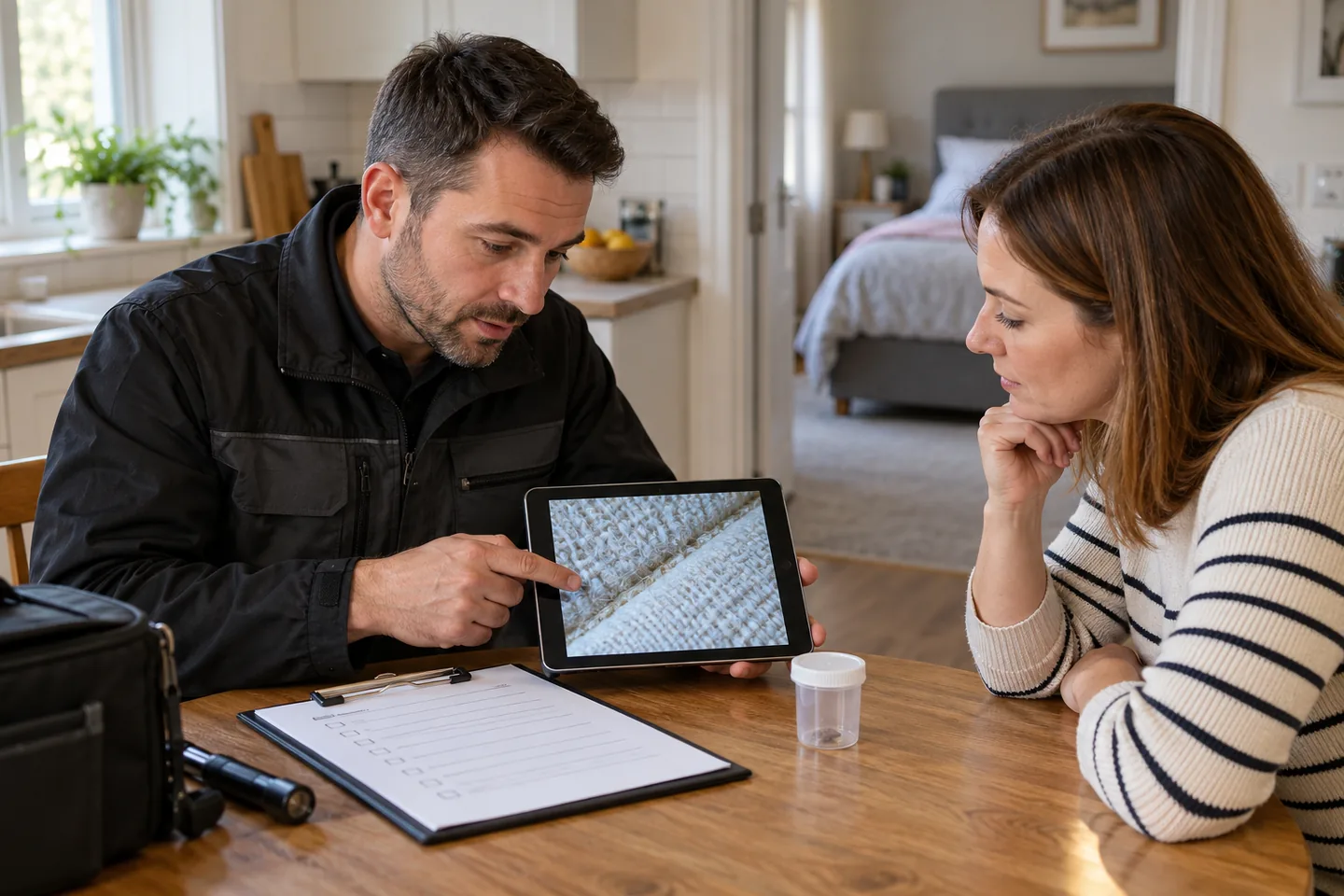
What happens when a suspected insect is found?
Finding a small insect is a useful starting point, but it still needs identification. Bed bugs can be confused with other small insects or old insect remains. The inspector may examine it closely or retain a specimen for confirmation if identification is uncertain. They should record where it was found, whether it is alive, and what other signs are present nearby. A photograph with a location note helps when rooms are compared later.
One positive identification may justify extending the examination to other relevant spaces, especially where people sleep or rest. It does not reveal the exact age or size of an infestation on its own. Conversely, failing to find an insect in a single visit cannot guarantee that none is present. Bed bugs hide well, access may be incomplete and activity can be intermittent. A careful written conclusion should reflect the evidence available on that day, rather than promise certainty the inspection cannot support.
A negative or uncertain result still has a useful next step
If no bed bug evidence is found, ask what areas were inspected and which were inaccessible. An inspector may recommend monitoring, another visit after a defined interval, or investigation of a different pest where there are specific signs. The value of a negative inspection lies in its documented scope and a sensible plan for new evidence. It should not automatically turn into pesticide treatment without a diagnosis. The BPCA code advises against pesticide application where evidence of bed bugs has not been found.
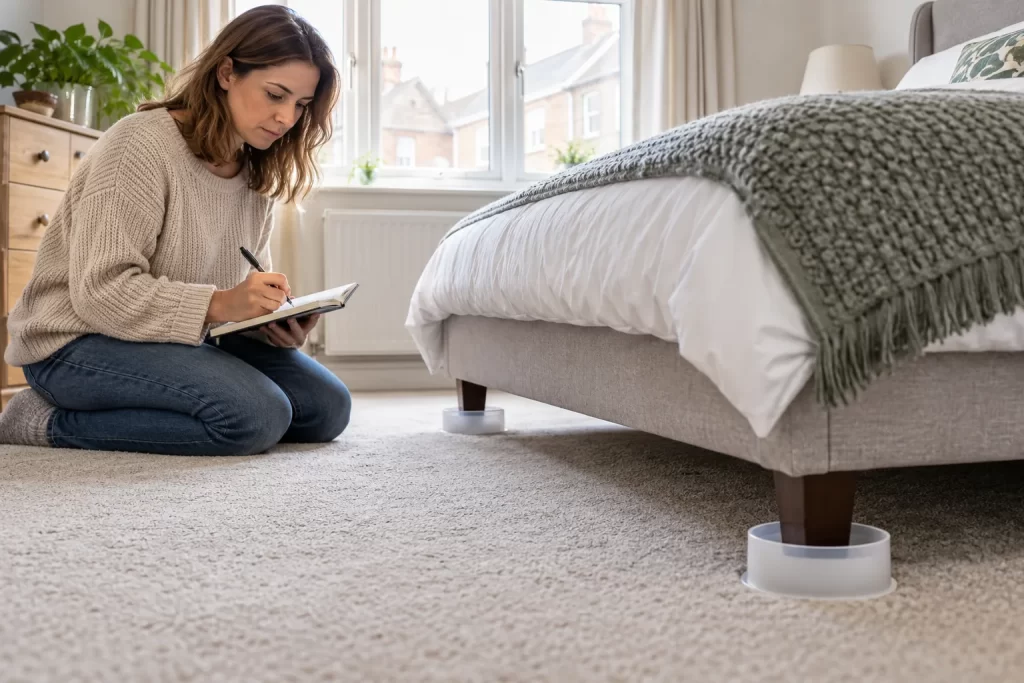
Monitoring can be especially helpful when the history is suggestive but the visible signs are weak. Devices can collect evidence over time, although their placement and the way results are interpreted matter. Our article on bed bug monitors explains what a capture can establish and why an empty device is not proof of absence. Agree who will check the devices, how often findings will be recorded and when the provider should be contacted again.
The findings should lead to a clear written recommendation
At the end, ask for a concise record of what was inspected, the signs found, any identification that remains uncertain, and spaces that could not be accessed. A proposed treatment should be tied to the actual findings. You should understand which rooms or items are included, what preparation is required, which method is proposed, whether follow-up is expected and what it costs. The US Environmental Protection Agency advises households to expect a professional to inspect and to discuss an integrated plan, potentially involving more than one visit.
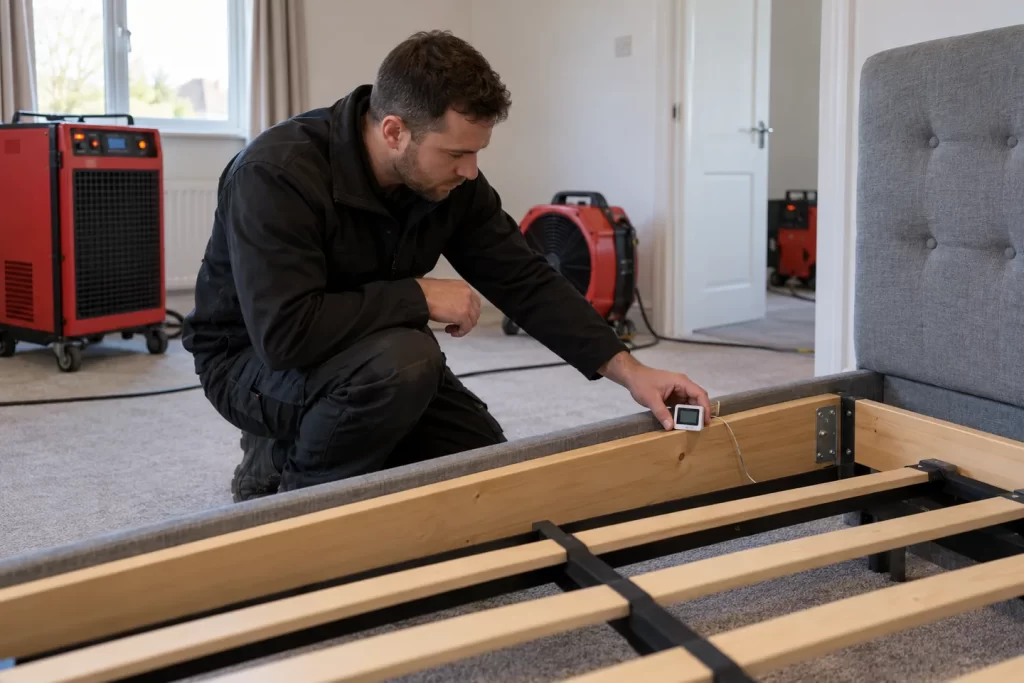
If heat treatment is proposed, ask how the provider assesses difficult areas and records temperatures within the treatment zone. Our heat monitoring service explains the role of measuring conditions during a heat job. The inspection itself does not prove that any later treatment will reach every hiding place; that is a separate operational question. You can also ask whether the provider has considered belongings that cannot safely be heated and what happens if signs recur afterwards.
If you are comparing quotations, compare scope as well as price. One quotation might cover only the reported bedroom, while another includes adjacent resting areas and a follow-up inspection. Ask whether each company has physically assessed the property, what assumptions it has made and what evidence would change its recommendation. For a property-specific assessment, the site's bed bug treatment team can explain its process and proposed scope.
A practical checklist for the appointment
Before the inspector arrives, collect your dated notes and photographs, keep any captured insect sealed, and identify the rooms and furniture associated with each report. Make the agreed areas accessible without transferring loose items from a suspect room into a clear one. At the visit, point out the exact locations of marks and any previously used products. Ask the inspector to identify what is confirmed, what remains uncertain and how the proposed action follows from the evidence.
Afterwards, keep the written findings, photos and any monitoring instructions together. If signs appear later, record the date and location before cleaning or moving the item, and send that information to the provider. A professional inspection is most effective when it produces a traceable account of the evidence and a realistic next decision. It is perfectly reasonable for that decision to be further monitoring when the evidence is incomplete.
Leave a Reply
You must be logged in to post a comment.